

By Jakob Strohl '26, staff writer
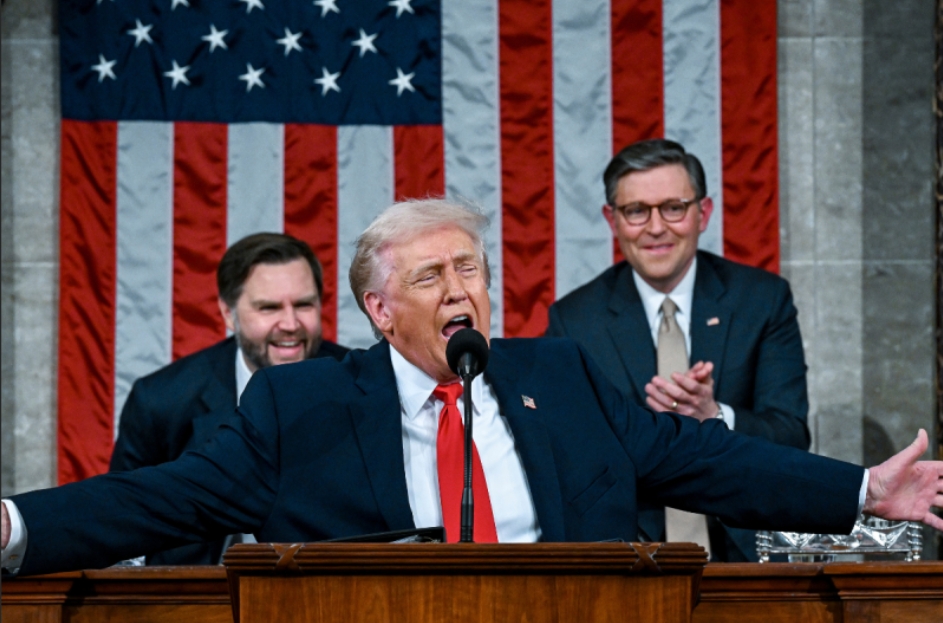
Of all the pointless tasks one might occupy themselves with on a Tuesday night, attempting to divine any policy objective from President Trump’s recent State of the Union must be among the most fatiguing. Three days out from what commentators have described as “a tedious, tiresome performance,” the Republican communication strategy for the midterms has failed to crystallize, a few key policy reversals have been left unexplained, and several salient foreign policy questions remain unanswered – and Democrats are not capitalizing.
The concept of a “unified message” has become all too literal in the groupthink of the Republican and Democratic parties. One insists on hitching its bandwagon to patent demagoguery, toasting moments that saw the President of the United States erroneously blame $19 billion of fraud in Minnesota on the clandestine protocols of the Somali immigrant community. The other locates its moral spine in ‘tediously, tiresomely’ repeating fact-checkers verbatim while staring blankly into the camera (shout out to Bernie Sanders for breaking that mold with a biting treatise on the fundamentals of poverty two days after the fact).
Yes, the President lied to the American public about virtually everything in his address. The catch for Democrats is that the vast majority of the American public has already pegged him as a serial liar, yet handed him a blowout victory over Kamala Harris in 2024 anyway. Continuing to beat this dead horse tows a petulant party line that betrays an obstinate refusal to work for the interests of Democratic constituencies if the town across the way went red. It isn’t hard to fathom a moment where a nearly breakeven amount of Americans would blame a party like this for a government shutdown, even when they retain no control over any of its branches.
To this redundancy of messaging, Virginia Governor Abigail Spanberger contesting Trump’s “golden age” remarks with the general vibe that life is less affordable than it otherwise might be fell dismally flat. That requires a subscription to the belief that, just over a year ago, voting for Harris and a Democratic Party that refused to run her in an open primary would not have extended staggering Biden-era inflation, home prices, and private-sector losses. Spanberger asking voters to discern Trump’s motives in office - percussively asking, “Is the president working for you?”- serves only to downplay existing literature that suggests the President’s motives are largely irrelevant in the context of his job performance (see Jimmy Carter’s ouster after the 1979 Iran Hostage Crisis). The only transparent juxtaposition that was drawn between the Democratic alternative and the State of the Union was one of a syrupy, measured, stock politician versus an addled bombast. Two of the last three times Americans were asked to make this decision, they chose the bombast.
What Democrats must do over the next several months is dissect the 2024 Republican victory and remain clear-eyed about what returned Trump to office just four years after January 6. The scaremongering claim offers only part of the explanation and condescends to moderates who resent having their deliberation branded as permissive of some putative existential threat to democracy. A sizable portion of the Republican victory rested on undermining voter confidence that Democrats had a plan – for immigration, for trade, for a faltering economy, and most importantly, for the future of their own party. Their version of America, though backgrounded by the morally-contested Project 2025, was lucid and articulable. Now, it is not. Especially with Iran.
---- Iran ----
On Tuesday, the President of the United States only managed platitudes about Iran being a state sponsor of terror, capping the precious few seconds of time he dedicated to the most pressing policy issue today with, “They want to make a deal, but we haven’t heard those secret words, ‘We will never have a nuclear weapon.’” Absent was any explanation as to why two carrier strike groups had been dispatched to the Middle East – what experts observe as the largest military buildup in the region since 2003 – or what role these strike groups will have in negotiations. By the same token, the Patriot and THAAD missile batteries being deployed are not force-projection measures, but defensive ones meant to insure U.S. bases in the region against expected retaliation for an attack the President has refused to comment on. But even this clichéd media observation was left relatively untouched by Democrats in their haste to decry misleading claims about drug price reduction.
What is Trump’s plan with Iran? As an exporter of both Middle Eastern terror via a dense proxy network and Shahed drones that Russia is actively using to slaughter Ukrainians, there is no mistaking that material regime degradation or kneecapping is in U.S. national security interests. But simply recognizing this on a national stage is insufficient.
Democrats now have the opportunity to articulate foreign policy before strikes happen, roping in disaffected analysts from a gutted State Department who understand that the robustness of Iran’s political infrastructure and chains of succession make kinetic action insufficient on its own for regime change and likely to galvanize efforts to develop breakout nuclear capabilities. The power vacuum left after Khamenei’s death, whether by leadership decapitation or age, also opens the door for a potential Islamic Revolutionary Guard Corps takeover that could install a further-right government more bent on acquiring a nuclear deterrent. This should be stated plainly.
Democrats must hammer this administration’s policy opacity and provide the American public with a concrete path forward. Telegraph whether stronger secondary sanctions are appropriate on those who traffic in Iranian oil, drone manufacturing, and agricultural products. Put forward possible red-line escalatory thresholds. Workshop transparency and uranium stockpile reduction incentives with European allies. It is time for the left-wing to remember its anti-war heritage and insist that “strategic ambiguity” cannot cloak executive overreach, uncooperativeness, and inaccessibility.
Be the first to comment