


By Chris Timasonravichkit '27, staff writer
Lebanon Valley College compensated President James MacLaren a total of $436,958 for the fiscal year ending in June 2025, according to an IRS Form 990 published by ProPublica.
A breakdown of MacLaren's $436,958 compensation package reveals he earned $373,258 in "base compensation;" $9,600 in "other reportable compensation;" $31,050 in "retirement and other deferred compensation" and $23,050 in "nontaxable benefits."
LVC presidents live at the official Kreiderheim residence. The on campus, college-owned property was valued at $593,000 according to the most recent assessment by the Lebanon County Board of Assessment. The housing benefit was not subject to traditional income tax and included in MacLaren's compensation package as a "nontaxable benefit."
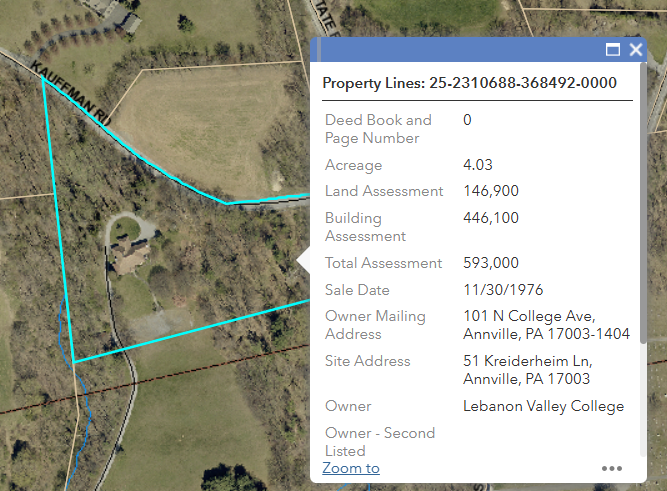
Photo caption: Aerial view and assessment of the Kreiderheim residence according to the Lebanon County Board of Assessment's Parcel Viewer. Land assessment, building assessment and total assessment values in U.S. dollars.
How the Board of Trustees determined President MacLaren's compensation
Joe Rilatt, Chair of the Lebanon Valley College Board of Trustees and Executive Performance & Compensation Subcommittee said the president's compensation is determined based on data from "comparable institutions."
"The Board also considers the scope and complexity of the president's responsibilities," Rilatt wrote in an email to La Vie Collegienne. "The presidency carries responsibility for the College's academic, financial, enrollment, fundraising, operational, and strategic performance for a community of more than 1,600 undergraduates, 400+ graduate students, and more than 500 faculty and staff."
In a conversation with La Vie Collegienne, MacLaren said his compensation is at the median for presidents "in [LVC's] peer set" and that it is determined by the Board of Trustees.
MacLaren said that the Board of Trustees also determines executive compensation for the senior college leadership based on institutions with a similar size and budget to LVC.
The average total compensation for college presidents at the 18 Division III Middle Atlantic Conference (MAC) institutions was $528,486.
Frustrated students voice a wide range of affordability concerns
La Vie Collegienne spoke with more than 20 students who felt as though senior administrators were out of touch with their financial hardships. The students raised a wide range of affordability-related concerns, such as the rising costs of tuition, fees, housing, meal plans and parking.
A senior music education student expressed frustration at rising costs saying, "They keep raising my tuition, raising my room and raising my meal plan, but they manage to pay that guy [President MacLaren] six figures."
In response to the music student's frustration, Rilatt wrote, "Affordability remains an important priority for LVC. The College provides more than $52 million in financial aid annually, and every student in this year's incoming class received financial assistance."
MacLaren said he sympathizes with students struggling to afford college.
"I know paying for college is a significant commitment for students and their families, and I never want a student to feel they have to navigate financial difficulties alone," MacLaren said. "If a student is struggling, I encourage them to meet with the Financial Aid team."
MacLaren said that financial aid counselors will try to make "equitable adjustments" to a student's aid package based upon their FAFSA and individual circumstances as well as help them explore other possible financial resources.
A junior history major whose family is in debt, but not in enough debt to qualify for financial aid, responded skeptically to the claim that the college cares about affordability.
"Tuition's rising every single year and the scholarships the upperclassmen have do not increase, but the incoming freshmen, those scholarships do [increase]," she said. "I feel like [LVC leadership] know[s] that students have money to be here and they're going to just like pay for it."
A history of tuition and fees increases at LVC
Annual undergraduate tuition and fees at LVC increased by $14,950, or 36.86%, from the 2016-17 academic year to the 2026-27 academic year, according to data reported to the U.S. Department of Education by LVC's Office of Institutional Research.
When adjusted for inflation, the real cost of annual undergraduate tuition and fees fell by $858, or 1.59%, from the 2016-17 academic year to the 2026-27 academic year. La Vie Collegienne adjusted the figures for inflation using the U.S. Bureau of Labor Statistics' CPI Inflation Calculator.
When asked about the increasing cost of tuition, MacLaren said that no LVC student pays the full sticker price. He said some colleges have done “tuition resets” where the sticker price is closer to the actual price students pay, but LVC keeps the current model in place where tuition is set at a higher price and student costs are significantly reduced by scholarships.
"These resets are not always successful, and the institutions end up raising their tuition again," MacLaren said.
"I would have left LVC if I didn't feel trapped"
The history student said merit-based scholarships helped reduce her tuition and fees to around $4,700 a semester; however, LVC's housing costs remained her biggest obstacle to affordability.
"I just can't afford to live here," she said. "Honestly, I would have left LVC if I didn't feel trapped, like most credits couldn't have transferred to another school because I'm from out-of-state."
The annual cost of room and board increased by 48.45%, or $5,320, from the 2016-17 academic year to the 2025-26 academic year, according to data provided to La Vie Collegienne by the LVC Office of Institutional Research.
When adjusted for inflation, the real cost of annual room and board rose by $1,029, or 6.73%, from the 2016-17 academic year to the 2025-26 academic year.
Student frustration was not limited to the rising cost of tuition, room and board. Multiple students expressed dissatisfaction with the college's new parking system, which increased the price of parking permits based on a lot's proximity to campus.
"They want to charge me $150 to park in red lot," a sophomore secondary education student said. "My car isn't even worth that much," she joked.
LVC's IRS filing and independent audit give a snapshot of the college's finances
LVC reported $128,287,012 in total revenue for the fiscal year ending in June 2025 according to the IRS Form 990. Around 88.29% of that amount, or $113,264,702, was generated in "program service revenue," which includes tuition, fees and "auxiliary enterprises" such as room and board.
LVC also reported $52,272,689 in debt, consisting of "notes payable" and "equipment and other notes payable," according to its Financial Statement & Single Audit Report conducted independently by the firm Baker Tilly. The report was for the fiscal year ending on June 30, 2025 and the combined debt was $1,361,054 lower than the fiscal year prior.
LVC generated $1,514,122 more in total revenue than total expenses for the fiscal year ending in June 2025. The fiscal year prior, LVC generated $890,818 more in total revenue than total expenses.
LVC's "Ever Forward" campaign aims to address affordability; increase endowment
On Oct. 2, 2026, LVC publicly launched its "Ever Forward" comprehensive fundraising campaign. The college announced that $68,714,805 has already been committed toward the campaign's $100 million goal.
Rilatt said the campaign, "includes a $30 million goal for scholarships and financial aid, $35 million for academics, and $35 million for the student experience."
Describing the campaign as a "sustained investment in our future," MacLaren said that "Thirty million additional dollars will help to increase the amount of financial aid available to students and reduce other pressures on the operating budget."
When asked whether students would see their tuition bills freeze or decrease as a result of the campaign, MacLaren said, “One of our most important goals with Ever Forward is to make an LVC education accessible and affordable. While the campaign isn’t designed to freeze tuition, it will help us increase financial support for students while continuing to invest in the academic programs, facilities, faculty and staff, and experiences that make an LVC education valuable.”
MacLaren noted that much of the scholarship funding from the campaign will be endowed, which means it will be invested as part of the overall endowment, with funds paid out at the annual spend rate. It does not mean LVC will have $30 million more in cash to spend directly on student aid.
When asked if he personally donated to the college, MacLaren responded, "Yes I give to the college." La Vie Collegienne did not inquire further as to how much the president donated or what campaigns he donated to.
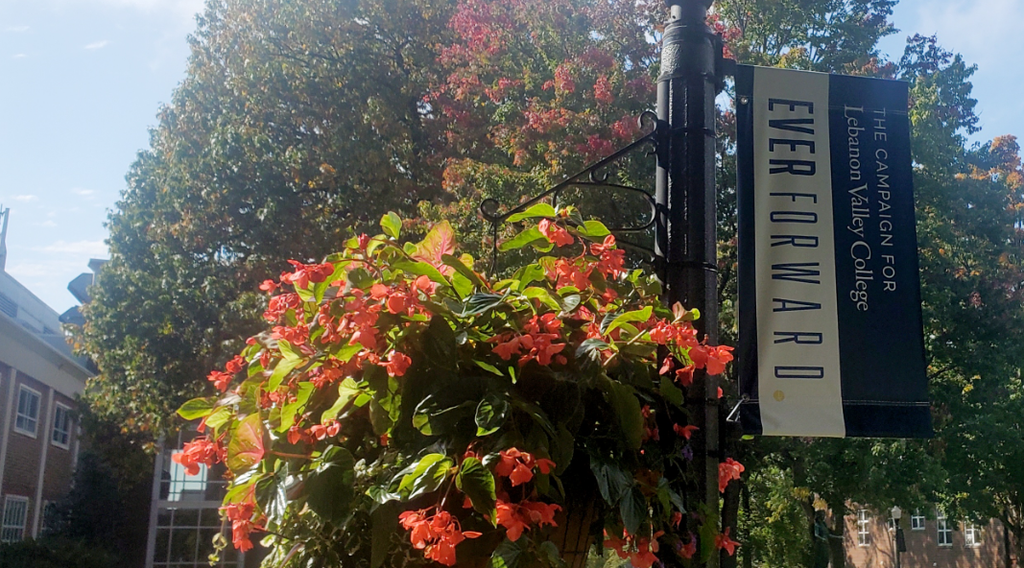
Photo Caption: An "Ever Forward" banner outside of the Vernon & Doris Bishop Library
LVC's endowment has grown
MacLaren also noted growth in the college's endowment over the past five years.
"When I started, the endowment was about $75 million," he said. "We are at about $130 million now."
He said a larger endowment will benefit LVC long-term by allowing investments in the college and its financial aid offerings, hedging against inflation and allowing for growth.
“A growing endowment strengthens LVC’s financial future," MacLaren said. "But keep in mind an endowment isn’t like a checking account: Many gifts are designated for specific purposes, and we must manage the funds so they support students for generations to come. We typically spend at a rate of about 4.5%, which generated about $3.4 million for our operating budget this year."
"LVC pays the worst:" An instructor's perspective
An adjunct instructor earning around $1,000 per credit hour a semester spoke to La Vie Collegienne on the condition of anonymity.
"Of all the colleges I have taught at, LVC pays the worst," he said. "I think the college should pay its faculty well because it's not like the students don't pay a ton of money to be here."
In response to the instructors' frustration, MacLaren said LVC wants to keep their faculty salaries competitive to recruit and retain talented faculty. He said LVC aims to provide faculty and staff with a 3% annual raise pool and that faculty compensation varies by academic department, length of tenure and seniority.
“I understand that the rising cost of living is putting pressure on our faculty and staff," MacLaren said. "We regularly benchmark salaries against those at comparable institutions, accounting for geography, and our salaries are at the median of that peer group. We also have worked to provide annual salary increases, with a goal of a 3 percent raise pool, when many schools have not been able to do so. We have also maintained a 9 percent retirement contribution, which is high compared to many workplaces."
MacLaren also acknowledged the challenge of meeting a desire for higher salaries amid rising healthcare premiums, energy costs and overall inflation, along with the need to present a balanced budget to the Board of Trustees.
“If I didn’t take a salary, we would still have to deal with these issues,” MacLaren said.