

By Jayden Sandoval '29, staff writer
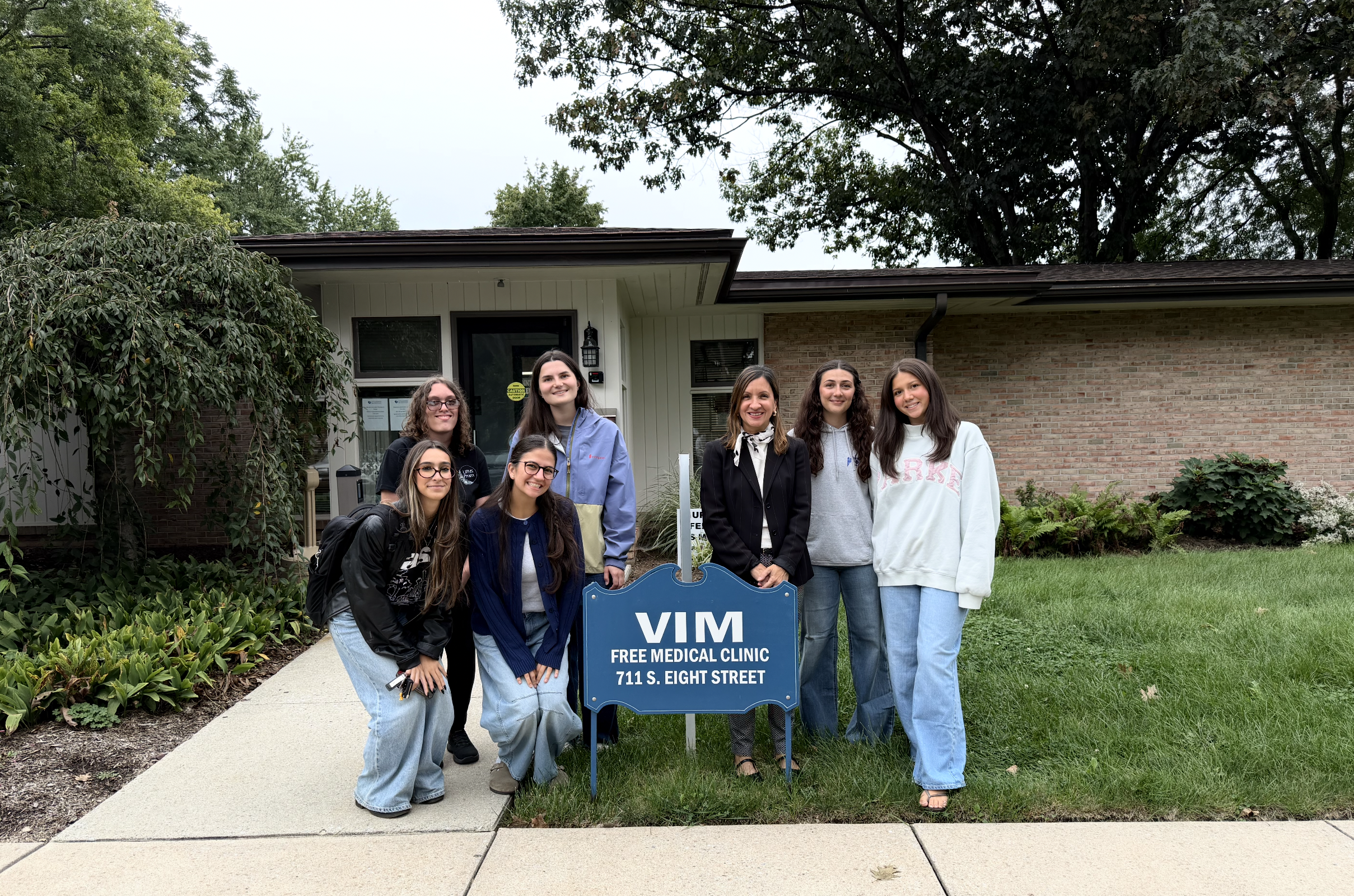
Stepping outside the classroom, students in LVC’s Spanish for Healthcare Professionals I visited a community-based free clinic to expand their Spanish vocabulary and to learn more about the needs of the Spanish-speaking community.
Dr. Ivette Guzmán-Zavala, a Spanish professor in the languages department, is most passionate about teaching at LVC is the SPA 323/324: Spanish for Healthcare Professionals I/II course.
In the course students are exposed to vocabulary in Spanish that they will use in a healthcare setting. Guzmán-Zavala enjoys teaching and getting to know what professions her students plan to go into. She has had the opportunity of teaching healthcare Spanish to students going into nursing, physical therapy, speech-language pathology, athletic training and the medical field.
Every semester Guzmán-Zavala has the opportunity of taking her class to a local clinic in Lebanon called Volunteers in Medicine (VIM). This is a clinic that offers free primary care services for anyone who needs it. Doctors, nurses and medical assistants offer volunteer care, and Guzmán-Zavala herself volunteers at VIM as an interpreter once a week.
“I think we don’t need to be in the classroom all the time to learn,” Guzmán-Zavala said. “You can learn outside the classroom. Changing the scenery, touching things, talking to someone who they don’t know, changing the direction, like where the class is set, helps them to learn even faster because we all learn in different ways.”
Ana Diaz is a nursing student at LVC who recently visited VIM with the rest of her class.
“I one hundred percent recommend this class and to visit VIM because it’s very important to have that in person interpretation with new technology sometimes not working out,” Diaz said. “And Spanish has different dialects, so it’s important to expose yourself to some kind of Spanish with it being one of the most common languages in the U.S.”
Guzmán-Zavala mentions how it is getting hard for the Hispanic and Latinx community to obtain medical insurance, but they still need medical attention. Clinics like VIM are important to have not only for the Spanish-speaking community but for all. She mentioned that for Spanish speaking patients, healthcare workers need to lean into the patient's culture and their language. She has seen Spanish speaking patient value this and when this is seen in practice, it creates a release of the tension.
“When you volunteer your time, you think you’re helping others but at the end, what comes back to you is so big and significant that you’re doing that to yourself,” Guzmán-Zavala said. “You really are getting something huge for yourself. That’s what my experience has been at VIM.”