

Reviewed by Abby Lavery
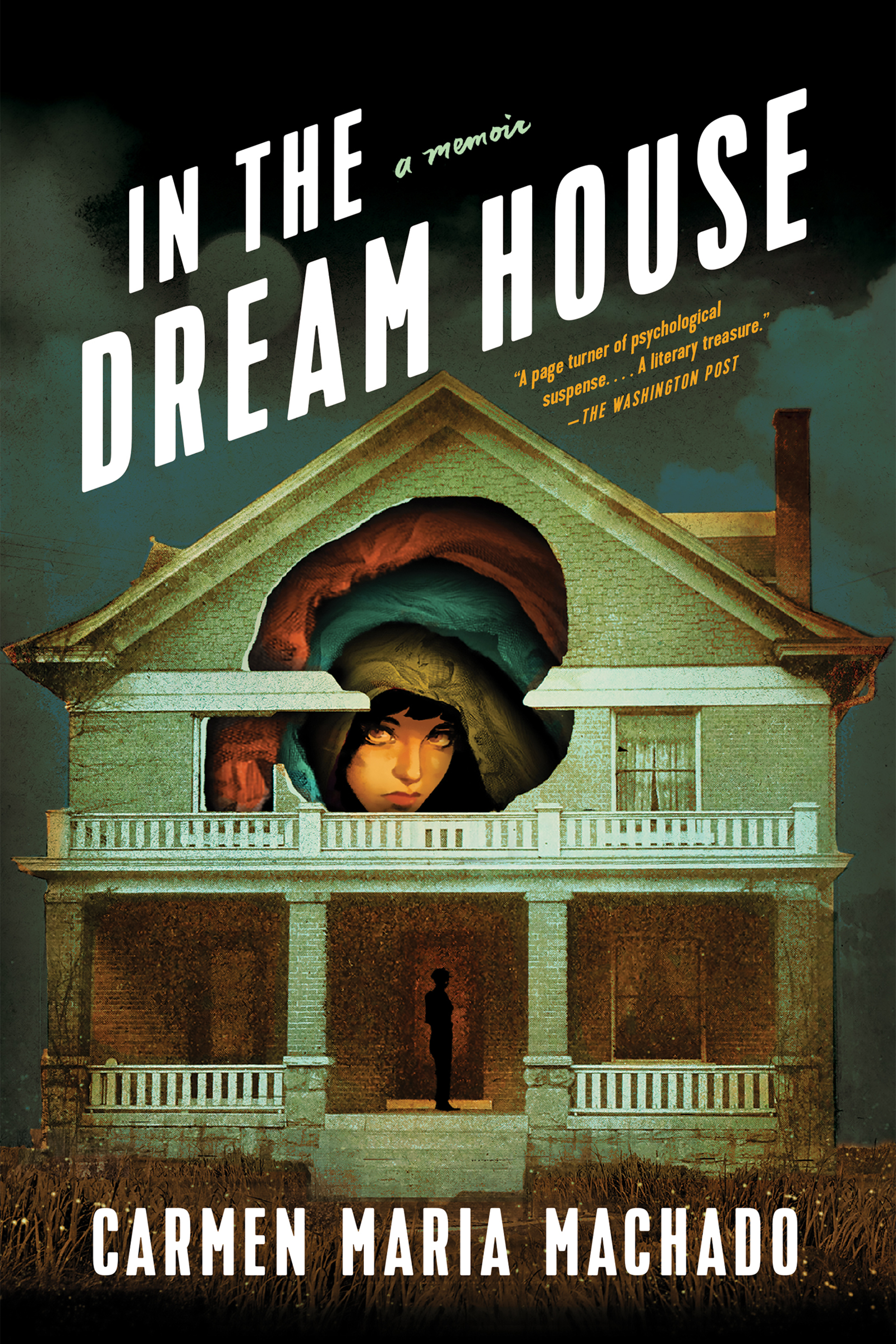
Carmen Maria Machado’s In the Dream House is more than a memoir; it dissects queer history, repurposes literary structures and tropes, and masters the use of setting, all while skillfully pushing against the boundaries of genre through fractured chapters spanning anywhere from a sentence to a dozen pages. The narrative centers on Machado’s abusive relationship with an unnamed woman, focusing on her responses to the manipulation and, eventually, how she comes to find her freedom. She tells her story through fragmented reflections, flashbacks, and scenes; each chapter is titled “Dream House as…” followed by the topic of the section, examples being “Dream House as Déjà Vu” (a chapter title that appears three times over the course of the memoir) or “Dream House as Heat Death of the Universe.” Some chapters are lighthearted, some quite the opposite, and Machado weaves them all together in a way that reflects the ups and downs of her relationship with her unnamed abuser. Machado ensures the cohesiveness of her musings by connecting her chapters through recurring themes and images, filling in the gaps in her narrative with allusions and careful research.
The effort Machado has put into her research is clear, especially in her sections devoted to uncovering queer history. One of her first sections discusses the concept of the abused woman and how “it—and she—did not exist until about fifty years ago,” which she follows by mentioning how “the conversation about domestic abuse within queer communities is even newer.” She writes about the idea of queer villains and her simultaneous love for their theatricality, juxtaposed against her understanding that “the system of coding” is problematic in “the way villainy and queerness become kind of shorthand for each other.” On queer villains, she concludes that she appreciates their moral complexity, as it suggests that being queer is not “equal good or pure or right” but that it is “simply a state of being.” Some of Machado’s research is specific to the experiences of women in queer spaces, like in the chapter “Dream House as Ambiguity,” which identifies “the curse of queer women—eternal liminality.” Machado does not shy away from critiquing the queer community’s tendency to ignore toxicity as a result of minority anxiety, which creates the pressure to be pefect and any failure is perceived as reinforcing stereotypes (“if you’re not careful, someone will see you—or people who share your identity—doing something human and use it against you.”) Her own doubts and hesistances shine through as she asserts rather sarcastically that “women who were women did not abuse their girlfriends; proper lesbians would would never do such a thing.” Her role as a queer woman gives her the space to make these criticisms, and Machado takes the opportunity to back up her own experiences with research to prove that her story is not unique.
Machado also pays homage to her background as a writer with sections that play with literary genre, structure, and tropes. She begins with an overture declaring that she hates prologues, followed by a prologue. One of her first chapters—“Dream House as Picaresque”—sets the narrative form for the memoirs, as a picaresque is an episodic story that typically involves travel and that follows a flawed by likable protagonist. Her awareness of story structures allows her to play with form; she titles her chapters with “Dream House as Inciting Incident” and “Dream House as Plot Twist” to show precisely those devices. She messes with genre, too, having a chapter titled “Dream House as Bildungsroman” that details her “coming-of-age” story when it comes to love and “Dream House as Choose Your Own Adventure,” a section that allows the reader to make choices from Machado’s life, all of which, of course, lead to a singular outcome. Her understanding of genre allows her to frame her life through other lenses, like fantasies, murder mysteries, spy thrillers, and romance novels, and demonstrates her literary prowess.
Machado uses the same techniques with common literary tropes, representing her life as a series of cliché yet nuanced events. She remains true to some of these tropes, like in her chapter “Dream House as a Stranger Comes to Town,” acts as a second inciting incident, and “Dream House as Meet the Parents,” where she, as expected, meets her girlfriend’s parents. Other tropes she skillfully subverts, an example being “Dream House as Star-Crossed Lovers,” when her girlfriend asks (demands, really) that they be polyamorous, or “Dream House as Mystical Pregnancy,” in which there is no true pregnancy but rather the fear of “the radical body modification that is pregnancy.” Again, this masterful usage of tropes and clichés illustrates Machado’s experience as a reader and a writer, which plays a central role in her recovery process.
The final recurring theme is more subtle: Machado frequently titles her chapters after settings. In some way, this is a reference to dislocation, which Machado defines as a common abuse tactic where the victim “is made vulnerable by her circumstance, her isolation. Her only ally is her abuser, which is to say she has no ally at all.” Settings also play into the “picaresque” style of fiction, as it often involves large amounts of travel, which, by default, requires various locations. However, Machado also clarifies that “places are never just places in a piece of writing” and “setting is not inert.” Some of her settings are real-life locations (“Dream House as Cottage in Washington” and “Dream House as 9 Thornton Square”) while others are metaphorical (“Dream House as Inner Sanctum” and “Dream House as Sanctuary). Her focus on setting feels reminiscent of Jane Eyre—and many other beloved classics—in the importance placed on settings. Then again, the memoir is titled In the Dream House; the reader is introduced to the main “setting” of Machado’s story before they even pick up the book. In the Dream House is a genre-bending memoir written as an act of healing. Machado’s vulnerability is striking, and her knowledge of literary structures and tropes allows her to push against the boundaries of what is expected of a memoir with masterful precision. Her message is powerful and laced with warnings. “A reminder, perhaps,” Machado says, “that abusers do not need to be, and rarely are, cackling maniacs. They just need to want something, and not care how they get it.”
Abby is a third-year English, creative writing, and history student at Lebanon Valley College. She can usually be found reading, writing, or yearning for a fantastical adventure. You can follow her creative journey on Instagram at @abbyaceofbooks.