

Reviewed by Samuel Bross
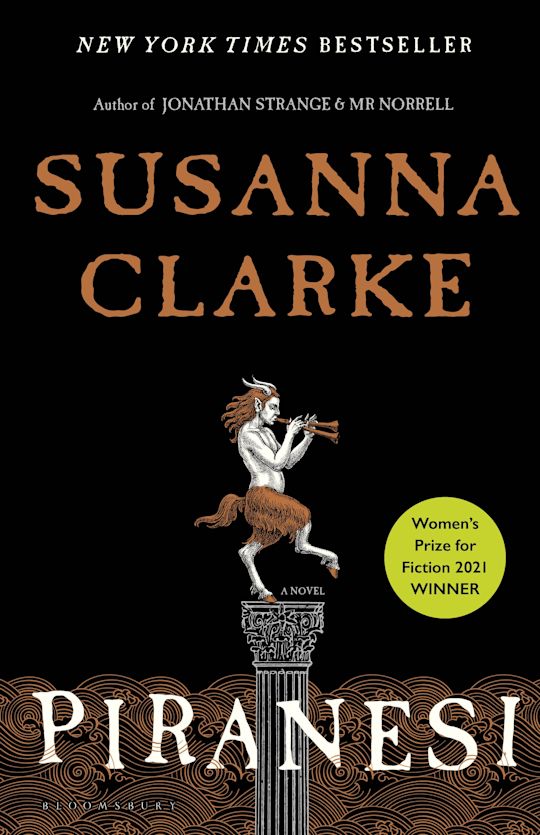
Susanna Clark’s second published novel could be considered a bizarre, adventurous piece of fantasy fiction. The story’s main character, Piranesi, is trapped in a “house” so big that it appears to have no end. The architecture is old and immaculate, and the design is as alien as it is inspired. Statues of every kind, representing every human idea from a bygone era, are planted in every available space in every hall and vestibule. They inexplicably vary in size and convey wordless, picturesque themes. Of course, for the lost Piranesi, none of this should have any inherent meaning. As long as Piranesi can remember, he has spent his whole life in this house with no one for company besides one aloof, severe, and prickly friend. He knows no history besides his own, and no other world exists for him so that any idea contained in the house may seem familiar. As far as he knows, the scenes portrayed in the anomalous statues are the first coming of their nature. Minotaur, mountains, fauns, and gardeners, all frozen in time. They are only statues, although he knows their names. Strangely enough, he knows.
This is because Piranesi, the book, is not really the adventurous epic that it may appear to be at the start. In 240 pages, the immense worldbuilding and character development doesn’t mesh together in the same way it would in a thousand-page tome. Instead, Piranesi treats itself as something a little less conventional. Convention, in this context, is the matter of the genre and not the content. Piranesi already excels at its bizarre narrative, but it is the goal of the plot that comes unexpectedly as the novel moves through its events. At first, this looks like nothing other than an extensive documentary of a strange place. As it is called by Piranesi, “The House.” There are notable statues, flocks of various birds, fish, tides, ruins, and the dead. The dead number thirteen, and Piranesi believes that, including himself and the other character simply called “the Other,” this makes up the fifteen people that have ever existed. Being a book about people, Piranesi takes a generous portion of time to reach this impactful implication.
Around this point is where the story’s theme comes a little lighter. Clark has crafted the character of Piranesi to be many things for this purpose. First and foremost, he is the writer. Every word of the novel is spoken either through Piranesi’s voice or written as a record of some other source, in Piranesi’s hand. Second to this, he is lonely. He is incredibly lonely, and while he loves his “House,” the whole book takes opportunities to portray Piranesi’s subtle reflection and recognition of his dire social state as per his world. Early on, in writing about the thirteen remains of deceased inhabitants, he comments on what appears to be a dead child: “I have postulated that the House intended the Folded-Up Child to be my Wife, only something happened to prevent it. Ever since I had this thought, it has seemed only right to share with her what I have.” What any reader with a memory of loneliness might see here are the signs of desperation, a clever play on Clark’s part. Piranesi’s distraught condition is only detected with recognition of this desperation, although for as long as he can remember, it is all he knows.
Third to this is the slew of details which Piranesi cannot, in fact, remember. Without spoiling the contents of the story’s juicier parts, the most that can be said is a hint of some connection to the real world. It’s a concept with a similar taste to Clive Barker’s Imajica, taking the ideas of fantasy and interpreting them through zero world European speculation. Unlike Barker’s 800-page novel, though, Clark makes room only for a glimpse of an epic, hence the rank of Piranesi’s other qualities. Where cities and landscapes shine in Imajica, it’s their absence that gives Piranesi its value.
Likewise, one of the plot’s biggest focuses is Piranesi’s loneliness. Later on, his writing takes on an increasing disturbance in the social aspect. As it is established early on, Piranesi has only one friend, and this friend does not treat him nicely. Piranesi eventually comes closer and closer to meeting other people. He finds a note on the ground asking logical questions, and he responds accordingly on the back. He leaves an extra note, starting with “1. If you are alive, then my hope is that you will find this letter and that the information I have given will be useful to you. Perhaps one day we will meet.” Following this, Piranesi instead explores what he believes is far more likely, the possibility that the foreign writer is dead. Despite this, he is plagued with the unobtainable goal of meeting another person. There exists a cycle here that makes the story of Piranesi so alluring: The common concept of longing and helplessness, of loneliness.
The book doesn’t end in despair, however. In fact, it doesn’t even begin that way. To take a context-hungry quote from the end, it looks more like a profound unawareness of an otherwise dire situation. Upon an event that familiarizes Piranesi with the thing he has been missing all his life, he writes, “Instantly, and to my huge embarrassment, I started crying.” It’s for the mixed joy of the story’s conclusion that he cries, however. And, soon after that, Clark’s book ends without much of the epic adventure otherwise expected, although still full of intense logistical drama and worldbuilding. Just as immaculate as the house, it contains a story of loneliness and recovery, and the conclusion leaves a bittersweet message of leaving the fantastical worlds of loneliness for the necessary comfort in real world.
Samuel Bross is a sophomore English and creative writing major at LVC. His interest in novels and publication has driven him to explore the art form in three fully written works of his own and in many of the works he reads in his free time.